
Isha – Week Four

Last week Isha had a worrisome week after a cluster outbreak of COVID-19 in an expat area. However, she feels that things are going back to normal again. At her office things are also changing. If you want to know more about Isha, click here to read her bio.

Press the play button to find out some of the changes in her workplace, and how she thinks the government is handling the situation.

Current situation in South Korea 21-05-2020

The total number of COVID-19 cases has increased with 131 new cases in the last week. Four people have died because of the virus. Most of the new cases are connected to the clubgoer in Itaewon. In early May South Koreans were going back to what was called ‘everyday quarantine life’.  But the Itaewon outbreak led to fears for a second wave. If you want to know more about this, you can read last week’s article.

On Sunday May 17, experts of the Korea Centers for Disease Control and Prevention (KCDC) said that they do not think it is likely that the Itaewon outbreak will lead to a next big wave. At that time 168 cases were linked to the Itaewon case in two weeks’ time. On Thursday the 21st the total number of related cases was 206. More than 60.000 people have been tested because of this outbreak. Jung Eun-kyeong, director of KCDC, said: “While the Itaewon outbreak is not projected to become as explosive as a peak witnessed in February, the situation is still far from reassuring”.
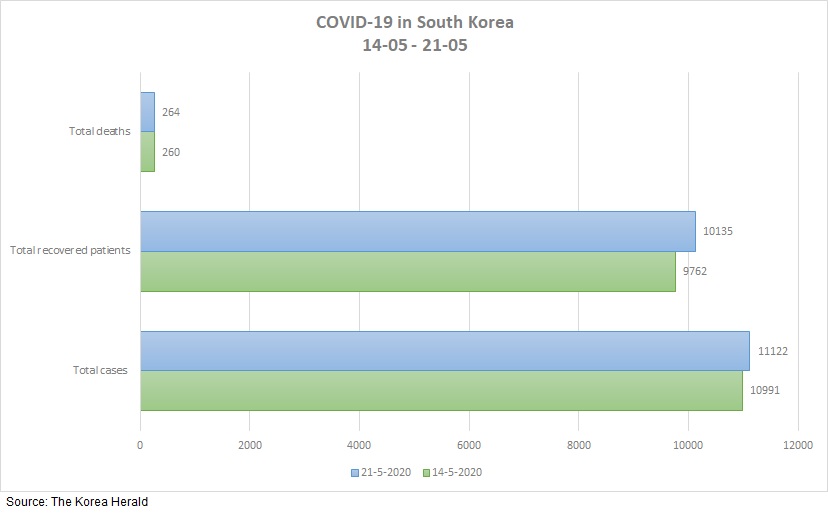
There has been a slight increase in cases of 131 in South Korea during the last week.

New outbreak in hospital
After the initial scare about the Itaewon outbreak, there was a second scare. Four nurses at Samsung Medical Center, a large hospital, got infected. Two of them did not show any symptoms. Mayor of Seoul Park Won-soon said they needed to respond carefully and sensitively, because there is a possibility of more patients. A total of 1418 people who had been in contact with the nurses got tested. So far none of these people seem to have corona.

Since Sunday the 17th of May there were about fifteen new cases per day. This spiked to more than thirty cases on Wednesday May 20. This is the highest increase of new cases in nine days.

Reopening of schools
In the midst of this high spike some schools reopened for the first time in 79 days. The reopening will go in phases, which will be fully completed by the 8th of June. On the 20th of May senior high school students could go back to the classroom. The reason that this group could go first, is because of the country college entrance exam, which has been postponed till the 3rd of December.

Not everyone thinks the reopening of schools is a good idea. A petition to postpone the reopening got more than 230.000 signatures. However, there are measures to reduce the risk of infections. The sizes of classes are reduced, there will still be some online classes, children are checked for symptoms, such as fever, twice a day, it is mandatory to wear a facemask, and there are plastic dividers in the cafeteria.

Two students tested positive
The first day of the high schools reopening went quite smoothly. But in Incheon 66 students had to go home after two of their classmates tested positive. These two infected students are probably related to the Itaewon case. Students are advised to stay away from places where there is a high risk of infection.

Extras
Curious what the schools look like with the new measures? Take a look at these photos from the first day of the reopening.

Most people in Seoul think that the pandemic will not end this year. Look at this graph to see when residents think the corona crisis will end.

A soccer team in South Korea decided to use seat fillers because people can’t support their teams. Want to know what they used as seat fillers? Read this article to find out.

Previous stories on South Korea:
Week 1
Week 2
Week 3

Ananya – Week Four

Last week Ananya told us about her online classes and how she was feeling more relaxed, but she also started to feel a bit gloomy. This week she decided to do things differently. If you want to know more about Ananya, click here to read her bio.

Press the play button to hear what Ananya has changed to make her feel more peaceful.

Current situation in India 18th of May

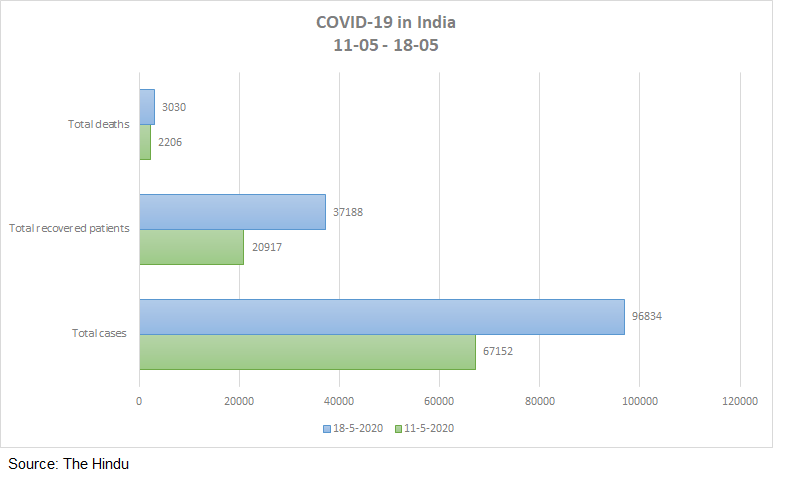
The numbers kept increasing last week, on Monday the 11th of May India saw its highest single day peak of COVID-19 cases. It has not slowed down this week. Since Friday May 15 India has more number of cases than in China. However, India still has a lower death rate than China. In a week time the number of cases has increased by almost 30.000. 824 people have died since last week.

Prime Minister Narendra Modi has said that it will not be possible to completely end the lockdown in India. The lockdown got extended with another two weeks. However, there’s now an ease of restrictions in some areas. Restaurants can no operate as a take away service, and private cars can drive across different cities. If you want to know what now is allowed in India, watch this video.

The number of COVID-19 cases in India has been raising a lot more than before.

Migrant workers
Modi wants migrant workers to reach their homes in their native place before the 22nd of May. The migration of these people have caused a lot of problems. Special trains were introduced but there are still people walking instead. There have been a few accidents in which more than ten migrant workers got killed in road accidents.

In Bihar food packages would be handed out for returning migrant workers who finally reached home. The person who was supposed to give the packages got mobbed by the hungry workers. This led to fighting and a lot of violence.

Nirmala Sitharaman, Finance Minister, announced that 3.500 crore Indian rupees will be spend on free food grains, like rice and pulses, for migrant workers for the next two months. According to some people this relief package comes too late.  

There are still individuals who help the migrant workers when the government is lacking to do so. One example is Baskar Seshadri who gives people tea and biscuits. On his Facebook page he comments on what he encounters during this volunteering. Click here to read some of his stories.

Animals
There are estimated 35 million stray dogs in India. Stray cats and cows are also common. Normally these animals feed themselves mostly with food scraps that people or street vendors leave behind on the streets. But because of the pandemic, it is hard for them to find food. That is why food programs for animals have become much more important. As if this was not difficult enough, rumors of animals spreading COVID-19 has led to people dumping their pets.

Besides charities people themselves also take initiative to feed stray animals. This gave a 63-year old man the nickname ‘the cat man of Mylapore’. He has been feeding stray cats for almost twenty years now. Because of the lockdown he couldn’t feed all the cats. That is why volunteers help him now to feed cats at different locations.

Vulnerable people
Heat killed approximately 350 people last year in India. With summer approaching this is raising concerns for people who do not have a cool space to stay at during the lockdown. In New Delhi temperature has already reached 41 degrees Celsius. The forecast does not look good, because it is predicted that India’s summer will be warmer than usual. Since people are forced or advised to stay inside their homes, it is important that power and water supply will be ensured on peak days.

What have states done to help?
1.77 million people are homeless in India. A few states like Maharasthra, Kerela and Delhi (note: Delhi is not a state but a territory) are helping these people with health checks and safety provisions.  But many other states, sixteen in total, that are home to fourty percent of India’s homeless population, have not taken any steps to offer help.

Seven states, such as Gujarat and Sikkim are providing food to some people. Some states, like Bihar, made new shelters. Only four states offer health facilities. According to experts the homeless are ignored by the government because they are being invisible. Want to know what authorities could do to help homeless people in India? Read this for more information.

Dharavi
In the article of last week you could read about an outbreak of COVID-19 in Dharavi. On Monday the 18th of May the total number of cases in this slum has been raised to 1200. Over fifty people died because of the virus. For more information you can read this article.

Extras
On the 5th of August 2019 Kashmir got a security lockdown due to a constitutional change of Article 370. When they just got out of this lockdown, the COVID-19 lockdown was imposed. Read this article if you want to know more about how Kashmir is doing under these circumstances.

There have been a lot of struggles for migrant workers who want to reach home. This article shows twelve short videos of the situation of these people (the videos are not in English, but you still get a view of what the conditions these people have to face).

If you would like to know how migrant workers can be protected, watch this video.

Although there are no cases of the virus on Antarctica, they did impose a lockdown. If you are curious about life on an Indian base on this continent, you can read this article.

Want to know how the current situation influences the lives of women in India? Read this article.

Want to know which areas got the most corona cases? Take a look at this interactive map.

Previous stories on India:
Week 1
Week 2
Week 3

Kranti – Week Four

This week Kranti has been missing some of her activities, like dance classes and swimming. She is less worried about Belgium, but now she worries about the situation in India. Kranti also discussed something important with her roommates. If you want to know more about Kranti, click here to read her bio.

Press the play button to find out what issue Kranti discussed with her roommates.

Current situation in Belgium 17-05-2020

Last week there was an ease of some restrictions for the first time since the lockdown. Since last week the number of cases has risen with 1831, and 345 more deaths. There number of corona patients in the hospitals and ICU is decreasing. That means there is less pressure on the hospitals. The number of deaths has also been dropping steadily.

However, the month of April has been the deadliest month for Belgium since the second world war. The peak was between the 1st and 12th of April. 639 people died on April 10, which is twice as much than usual. But the number of deaths may be overestimated, because it also includes deaths in nursing homes that were not officially confirmed to be caused by COVID-19. Nonetheless, a professor of demography thinks the numbers are pretty accurate.

Last week special contact tracers started to trace down people that had been in contact with an infected person. So far they have only been able to trace back about fifty to sixty percent of the patients contacts.

The numbers of yesterday compared to the data from six days ago. There’s a slight decrease in the number of patients at hospitals/ICU.

Death number
When looked at the number of COVID-19 deaths in hospitals of several European countries, Belgium scores worse than the Netherlands, the United Kingdom and France. It is unknown what the reason behind this is. The dense population may be a factor. Steven van Gucht, Belgian virologist, says it is too early to draw any conclusions.

High number of tests
One of the steps in the strategy of Belgium to end the lockdown is to do more testing. According to numbers on Statista and Our World in Data, Belgium is now in the top three countries when it comes to testing.  They test around 19.900 people per day. Relatively speaking this comes down to 40.914 people per 1 million citizens. Neighboring country the Netherlands tests 13.768 per 1 million people, and in Germany it is 30.400 per million.

Phase two of the exit strategy
On Monday the 18th of May the second phase of the exit strategy will start. This means museums, zoos and libraries can reopen. The open air-markets can start again and people will be able to get a haircut. Funerals and weddings will be able to have up to thirty guests. There can be sport trainings outdoors of maximum twenty people. Also children will gradually go back to school.

1 in 4 Belgians gained weight
During the lockdown people were still allowed to cycle, go for walks, or go jogging as way of exercising. However, thirty percent exercised less than they normally do. According to this large-scale poll with 40.000 respondents, one in four Belgians gained weight since the corona crisis. This might be caused by all the sitting down. The percentage of people sitting down, or resting, for eight hours or more per day has doubled when compared to 2018.

The study also showed that people have been consuming less alcohol than usually, while people do tend to smoke more.

It might not have helped in the fight against weight gain that Belgians were asked to eat more fries. This was asked because there is a surplus of 750.000 tons of potatoes in the country.

Extras
The world’s biggest flower has been blooming at the botanical garden of Meise. If you want to get a look watch this video.

Can you use some positive news? Read this article for some good news from the last few weeks.

Curious how hairdressers can do their job next week? This article explains it all.

If you would like to know more about when the border with the Netherlands will reopen, you can read this article.

Previous stories on Belgium:
Week 1
Week 2
Week 3

Yve – Week Four

Since there has been an ease of some restrictions in Australia, Yve worries there will be a second wave of COVID-19. She also got to know she has to shift from online teaching to teaching in a classroom in three weeks time. If you want to know more about Yve, click here to read her bio.

Press the play button and listen how Yve feels about returning to teach at school.

Current situation Australia 15-05-2020

The numbers of COVID-19 cases are still not rising that much in Australia, when compared to some other countries. Over the last week there have been 75 more cases and 1 death related to the virus. Last week the three-step plan was introduced. If you want to know more about this, you can read the article from last week.

There is a lot of difference in the ease of restrictions per state or territory. Yve lives in Victoria, and last week there was no ease of restrictions. But as you have heard from her, this week things have changed. Last Wednesday on May 13, after about 2 months, there has been some relaxation of the restrictions. People can now do things like day hikes in nationals parks, golf, fish and organize small dinner parties with up to 5 people. Weddings and AA meetings can have up to 10 guests.

The ease of restrictions also raises some concerns, like Yve pointed out. There have been some concerns over busy shopping centers, after some shops could reopen after a month of being closed down. According to some people it was busier than during Christmas. Yve is not the only one who is worried for a second wave. You can read this article if you want to know more about how likely a second wave in Australia will be.

There has been a slight incease of 75 in the number of cases since last week.

Infections at McDonalds
Two people who work at McDonalds in Victoria got COVID-19. They did not work at the same location, but they were relatives. The two McDonald restaurants decided to close their doors. After a big cleaning and installation of protective shields, the first McDonalds decided to open again with employees from other establishments. All of its ninety employees are being tested. There are now eight cases linked to the first McDonalds restaurant.

The number of cases that are linked to the outbreak at Cedar Meats has been growing to 90. The Chief Health Minister of Victoria said that the factory should have probably closed sooner.

International students
International students have a hard time since some of them lost their job, but they do not qualify for benefits or any other support. A restaurant decided to give free meals to these students, this led to long queues of people waiting on the streets. Prime Minister Scott Morrison has told foreign students who cannot support themselves should go home, which is easier said than done for some people. If you are curious about some of the stories of international students read this article.

The Victorian government made arrangements for international students to get a relief payment of up to 1.100 Australian dollars.  

Indigenous communities
Corona laws prevent people from indigenous communities in Queensland from attending school, fishing for food and leaving to buy essential products. The indigenous communities will remain in lockdown, even though there is an ease of restrictions in the rest of Queensland. Read this for more information.

Ease of restrictions in New South Wales
New South Wales started with step one of the recovery plan on today Friday the 15th of May. This means up to ten people can gather outside and cafés, restaurants and pubs can have up to ten guests. In most eastern states, except for Victoria, restaurants and cafés will reopen their doors for max ten people.  

Read this article if you want to know what is allowed in which state.

Extras
There is a trade dispute going on between Australia and China. If you are curious and want to know more, you can read this article.

An extra of 481.5 million Australian dollars will be provided by the Federal Government for a mental health plan. For more information read this.

Yve talks about the strategy of Victoria for students to return back to school. You can read this article for more information.

Want to listen to the latest news on COVID-19? You can try the coronacast podcast from ABC.

If you are curious about how corona has spread in Australia, you can take a look at these charts.

Readers of ABC said that because of the lockdown their household duties have changed in their family and the division of chores has shifted. Read this to find out more.

Previous stories on Australia:
Week 1
Week 2
Week 3

Isha – Week Three

Isha feels like things are back to square one in South Korea. After an ease of the restrictions there was a rise in infections again, which led to the reverse of some of the relaxations. If you want to know more about Isha, click here to read her bio.

Press the play button and listen to how the last two weeks have been for Isha.

Current situation in South Korea 14-05-2020

A week ago South Korea eased restrictions and adapted to what they called ‘everyday life in quarantine’. However, last week there was a slight spike in numbers because of a patient who went clubbing in Itaewon. If you want to know more about this, you can read the article from last week.

Things have not improved, and the number of cases has been increasing to about 30 new cases per day. There are now more than 130 new cases linked to the cluster outbreak in Itaewon. Authorities now estimate that 7.200 people have visited the same places as the Itaewon patient. This has led to a fear of a second wave. Prime Minister Moon Jae-in said: “We must never lower our guard regarding epidemic prevention”, and “It’s not over until it’s over“. Because of the rise in infections authorities decided to push back the reopening of schools by one week. Clubs and night bars are also still closed.

Over 35.000 people that were linked to the recent outbreak got tested for COVID-19. The tests were free and anonymous. According to the mayor of Seoul, Park Won-soon, everyone that visited clubs in Itaewon between the 24th of April and May 6 should get tested. If people do not adhere to this, they can get fined.

There has been a rise of 169 cases of COVID-19 since last week.

LGBTQ+ community fears testing
The strategy of South Korea to prevent the virus from spreading is to test, trace and contain. People who went clubbing had to write down their names before entering. Authorities are now trying to track these people down, but there is a problem. Itaewon is a district with nightclubs that are more welcome to people from the LGBTQ+ community. Some of the clubs the Itaewon patient visited are popular with gay men.

However, the country itself is still conservative when it comes to LGBTQ+ acceptance. That is why some people wrote down fake names, which makes tracking them down impossible. Some people are too afraid to respond when the authorities contact them. The situation has already led to homophobic comments on social media.

Foreign community in Itaewon
Itaewon is a multicultural part of Seoul and it also has a big expat community. Because of language barriers some foreigners feel excluded, says a Turkish student who also went clubbing in Itaewon. All the information and alerts that she receives are in Korean, even the result of her COVID-19 test. If people do not translate the messages they receive, they might not be aware that they should test after having gone to clubs in Itaewon.

Because Itaewon is known for its expat community, some employers wanted their foreign employees to get tested. Some people said it felt like discrimination, while others understood the worries of the companies they work for.

Extras
Want to know more about LGBTQ+ discrimination in South Korea and the problems with the Itaewon cluster? Read this article, or this one.

Ever heard of ‘colatheque’? If you’re curious, and want to know more about the clubbing scene in South Korea you can read this article.

If you want to know more about fears of a second COVID-19 wave, privacy concerns over the tracing of people, or the situation in North Korea, you can read or watch this interview with Kang Kyung-wha, the foreign minister of South Korea.

Previous stories on South Korea:
Week 1
Week 2

Ananya – Week Three

Last week Ananya told us that she would try not to stress about not having anything to do. This week she will tell use how she managed to do that. If you want to know more about Ananya, click here to read her bio.

Press the play button to hear how Ananya found some more rest during the lockdown, and hear how her online colleges are going.

Current situation in India 11-05-2020

Today on Monday the eleventh of May India has seen its biggest spike of COVID-19 cases. It rose with 4.213 new infections in one day. In the meantime, there has been an ease of the restrictions in some areas. Last week the ‘zone strategy’ was announced. After weeks of staying at home, the lockdown got extended again. However, during this lockdown 3.0 some restrictions got eased. Read last weeks article for more information.

Slow start of the railway system
There has been no public transport since the 25th of March, but tomorrow, on Tuesday the 12th, fifteen trains will depart from New Delhi. Only people without symptoms can travel. Booking for tickets began today on Monday the 11th of May. Watch this video for more information about these trains, and the guidelines people have to follow. There have also been talks about resuming some domestics flights.   

There has been a big increase in the number of cases of COVID-19 in India in the last three weeks.

Special corona tax for liquor
Prime Minister Narendra Modi had a meeting today with state chief ministers to discuss a post-lockdown strategy. Modi stressed the necessity of ‘do gaaj doori‘, people should keep a distance of two yards between themselves and others. But there have been some problems with people not taking this into consideration. A big issue was the reopening of liquor stores, after weeks of being closed these shops could open in some areas. This led to huge crowds as you can see in this video. To overcome this problem Delhi imposed a special ‘corona tax’ of seventy percent to stop people from going to stores to buy alcohol.

Police will fight fake news
India has been struggling with fake news before, but spreading false information hasn’t stopped during the lockdown. That is why the Bureau of Police Research and Development published a guide for law enforcement agencies so they can identify fake news. There will also be videos in order to try to stop the spread of panic and hatred. There have been problems with people, and even Indian officials, wrongly blaming muslims for the spread of the virus.

Maharashtra train accident
There have been a lot of problems for migrant workers that want to return home. Sixteen migrant workers that were walking to their home (a 157 kilometer walk) got killed because a freight train ran over them after they fell asleep on the train tracks. The government now keeps insisting people and states to make use of what they call ‘shramik’, a train especially for migrant workers. Watch this video, or this video for more information about these trains.

Extras
Ananya talks about her online classes which are now covering the perspective of Carl Rogers. Watch this video, or this one, if you would like to know more about the humanistic psychology of Rogers.

As if there hasn’t been enough bad news there is also a rise of COVID-19 cases in Dharavi, India’s biggest slum. There are approximately 800 cases and 25 deaths in Dharavi. For more information you can read this article.

Karnataka, a state in India, is transforming several buses into health clinics to test more people. For more information click here.

The Indian Express Online has a podcast about how India has handled COVID-19 so far. Click here if you would like to listen to it.

Want to know more about fake news in times of corona? Watch this video with tips to recognize fake news.

Previous stories on India:
Week 1
Week 2

Kranti – Week Three

Things are changing in Belgium and Kranti is a bit nervous about it. The last week she has also discovered something positive that has happened the last few months. If you want to know more about Kranti, click here to read her bio.

Press the play button to find out what worries Kranti and which dilemma she is facing (note: the audio quality is not so good at the start, but it will improve).

Current situation in Belgium 10-05-2020

Today on the 10th, Mother’s Day, there is more relaxation of the measures. People in Belgium are now allowed to invite four people over at their house. The government is speaking of what they call ‘house bubbles’. Each of these bubbles can invite four people in their house, not all at one, but each at a different time.

These four people have to remain the same people. If someone of your household visits someone, this visit counts for everyone in the household. Even if the visit was only done by one member of the household. This means that families have to choose wisely, between their own friends and family and their children’s friends.

Besides that, people can meet two people outside to go for a walk or exercise. The idea behind these ‘house bubbles’ is that these bubbles do not come in touch with other bubbles. If people decide to meet more than the four chosen people, than there will be so many ‘bubbles’ which could increase the spread of COVID-19. During the visits there are still some rules, like keeping 1.5 meter distance, and it is preferred to sit outside in a garden than inside the house.

The cases of COVID-19 in Belgium for the last three weeks.

Stores reopen
On the 11th of May the shops will open their doors again, but they have to take some precautions. People can only stay in a shop for thirty minutes, and only one customer is allowed per 10 square meters. Everyone over eighteen years old should go to a store alone, and people should go to shops close to where they live. No one is obliged to wear a facemask when shopping, but it is recommended. Some shopping streets have taken special measures, such as the Meir in Antwerp, where people will have to walk on the right side of the street.

Contact tracers
The last big change is that there will be 2.000 special ‘contact tracers’ to find out with whom infected patients have been in contact. When someone is sick, they have to tell this person who they have seen the last two days. People who have met a infected person will get a call, in some cases those people should then stay at home for two weeks.

After all of these measures the schools will open again on the 18th of May. On the 15th there will be a test day for schools, so they can check how well the measures, max ten children per classroom, work before they will open.

Belgium will also increase its testing capacity with 25.000 tests per day.

Extras
If you want to know more about the house bubbles, you can read this article.

You can read this article for extra information on the relaxation of the measures in Belgium.

Previous stories on Belgium:
Week 1
Week 2

Yve – Week Three

Yve is feeling a lot better this week. The weather was nice so she went to a forrest. She was glad to get some exercise, because she has noticed how much sitting down all day is impacting her physically. If you want to know more about Yve, click here to read her bio.

Press the play button to find out how going to the forrest helped Yve and what has been changing in Australia.

Current situation in Australia 08-05-2020

The National Cabinet came together on Friday the 8th of May to discuss an ease of the restrictions. The government decided to ease the measures in three steps which will be completed by July. Every three weeks the National Cabinet will discuss the progress of each step. During this review they will look at the impact of the relaxation on the numbers of infections.  States can decide when the ease of the measures will come into effect. Prime Minister Scott Morrison said: “Today, National Cabinet agreed a three-step plan and a national framework to achieve a COVID-safe economy and society.” He later added: “In this plan, we walk before we run”.

Step one
The first step is to reopen shops, restaurants and coffeeshops. People can travel within their region and gather outside in groups of maximum ten people. At home people can have five visitors at a time. Community centers, playgrounds and libraries will also reopen their doors.

Step two
During this phase groups of twenty people are allowed again in places such as cinemas, gyms and beauty salons. Interstate travel will also be allowed in some cases.

Step three
People will go back to their offices and workplaces in the last phase. Pubs will reopen and gatherings of a hundred people will be permitted again.

Difference between states
There is a lot of difference between the measures per state. In the Northern Territory there are already plans to open pubs and clubs in the coming weeks. In Western Australia people, inside or outside, can now gather in groups of ten people. Canberra will reopen schools on May 18, and Queensland has eased restrictions on gatherings and movement.

In Victoria (where Yve lives) it will take a bit longer before things will change, because they are still trying to contain outbreaks of the virus. After the nursing home there has also been an outbreak in the factory Cedar Meats.

Corona slang language
Australians are known for their slang in which they abbreviate a lot of words. The aussie slang vocabulary is now being expanded by words like ‘iso’, ‘quazzie’, ‘sanny’, ‘the rona’ and ‘the pando’. This last one means the pandemic. Experts say that this new slang is creating a shared understanding which brings people closer together.  Want to hear this COVID-19 slang? Watch this video. Or read this article for more information.

There are some issues with the COVIDSafe App, it might not work accordingly on older iPhones. The app has been downloaded by approximately 5 million people. Read this article ff you want to know more about these malfunctions. If you would like to know more about the app, you can read last weeks article.

Extras
If you would like to know more about the 3-step plan and a specific state or territory, check this link, or this one.

Yve talks about a ‘travel bubble’ between Australia and New Zealand. Read this for more information.

At the end Yve explains how the growth number is above one. If you would like to know more about this you can read this article.

Previous stories on Australia:
Week 1
Week 2