Isha – Week Two

This week there is no voice memo of Isha. Things took a turn for the worse in Seoul (read the article below) and she has been too caught up in current affairs. If you want to know more about Isha, click here to read her bio.

Current situation South Korea 08-05-2020

The first local case of COVID-19 in four days was announced on Thursday the 7th of May. However, for the last twenty days the number of cases has stayed below twenty per day. That is why since Wednesday the 6th there has been an ease of the restrictions into the so-called ‘routine distancing’.

Next week schools will open their doors again, and people can go back to their daily routines when they follow some simple guidelines. Jeon Eun-kyeong, Director-General of the (KCDC), said: “We ask all people to actively participate in the so-called everyday life quarantine that is aimed at coexisting both quarantine and everyday life”. With minimal steps the government wants the country to go back to normal life while still preventing the spread of the virus.

The difference between the numbers from the 8th of March compared to eight days ago.

Gyms, museums and libraries reopen
Libraries, museums and campgrounds are opening again. People can exercise in gyms, but they should bring their own workout towels. They are also advised to shower at home instead of the gym. The last few weeks people visiting gyms had to get their temperature checked, and had to wear a facemask during their workout. This is no longer necessary. Sport competitions will resume without visitors.

When people go to restaurants or coffeeshops they are advised to not stay too long. Movie theaters and concert halls have to block out some seat so people cannot sit close to each other. The audience is also advised to wear a facemask. Churches are recommended to not let people sing together because this is an easy way for the virus to spread via droplets.

New infections after infected person went clubbing
On Friday the 8th of May there was some bad news. After only two days of the new relaxed measures there was a new cluster infection. Fifteen new cases of COVID-19 have been reported to be linked to a patient that went clubbing in Itaewon, a neighborhood in Seoul. It is estimated that this person has been in contact with approximately 1500 people while going clubbing in three different places in the night of the 2nd of May. After going clubbing the patient got sick and he tested positive for the virus on the 6th of May.

This all happened four days before the relaxation of the restrictions.  Nightclubs and bars in South Korea got an administrative order to not open their facilities starting from Friday evening the 8th of May. Before this clubs were open, but they took measures such as checking the temperate of guests.

Extras
Curious about the clubbing scene in Itaewon? Watch this video.

Watch this video to get a view of the National Museum of Modern and Contemporary Art that just opened her doors again.

Want to know more about routine distancing? Read this article.

Ananya – Week Two

This week Ananya is feeling a lot better, she decided to cut herself some slack and to be okay with not being productive. If you want to know more about Ananya, click here to read her bio.

Press the play button to listen to how she was able to change her mindset and which new talent she discovered.

Current situation in India 03-05-2020

The 3rd of May was the day the lockdown might be over. Like Ananya said this is not the case, and the lockdown has been extended by two more weeks. However, there are some relaxations of the restrictions. The country is divided intro different zones. The red, orange, green or a so-called containment zones. Green zones are the safest, in these areas there have been no cases of COVID-19 for the last two weeks. Currently there are 319 of these green zones. Then there are 130 red zones, in these ‘hotspot’ districts there is a high number of active cases. The remaining 284 areas are orange. This means that they don’t fall into the green nor red category. Containment zones are smaller areas (approximately 30-50 houses) within a red zone that has more severe measures, such as house to house surveillance. What people are allowed depends on the zone they live in. But in general there is still a lockdown and not so much has changes yet.

Not allowed in any zone:
– Travelling by air, rail or metro
– Interstate movement by car
– Large public or religious gatherings
– Malls or markets
– All non-essential activities strictly prohibited between 7pm till 7 am
– Schools and restaurants are still closed

Allowed in every zone:
– Movement of by car for permitted activities
– Stand-alone shops can open again in urban areas
– All shops can open again in rural areas

There has been a big increase in the number of COVID-19 cases in the last week

Transport migrant workers
Good news for people in green and orange zones. Liquor shops will reopen because of the relaxation. Also more good news for stranded migrant workers, students and tourists. After they have been checked for symptoms, they can finally take a bus back home. This is unfortunate for farmers, since they are struggling with labour shortage because of the pandemic.

Hospitals
The lockdown was extended because the number of cases and the death toll have both risen a lot. When looked at the data it is not visible that there has been a lockdown, unlike Italy for example. Nevertheless, the outbreak is still not as big as some people worried it would be. The hospitals have still been able to manage the situation. However the big rise of cases is worrisome for hospitals in some places such as Chennai. To show gratitude, the Indian Air Force dispersed flowers from air across the All India Institute of Medical Sciences on Sunday the 3rd.

Extras
In the video Ananya talks about lathi beatings the police gave to people who disregarded the lockdown. If you are curious you can watch this video (warning: you will see violent images).

Want to see the divisions of the zones in India? Click here to see the map. Ananya is staying in a green zone.

The number of cases has been relatively low in India, although the last week there has been a big increase. There are lots of speculations what could be the reason behind the low number of cases. For more information you can watch this video.

Kranti – Week Two

Last week Kranti was quite positive about how her life changed because of the lockdown. This week she had a lot of time to think and she has made some discoveries. If you want to know more about Kranti, click here to read her bio.

Press the play button to listen to the positive and negative things Kranti has experienced this past week.

Current situation in Belgium 02-05-2020

From the 4th of May everyone above twelve years will be obliged to wear face masks in certain public spaces. The government decided this because the spreading of the virus is more controlled after the lockdown. Therefore, the measures can be slowly reduced. When, in the near future, people can go outside again, changes are necessary to prevent a second outbreak of COVID-19. That is why people have to wear a face mask in public transport. Face masks are also obliged in crowded public spaces such as school. The goal of wearing a face mask is that people don’t spread the disease to the others around them easily. Face masks can be self-made, but it can also be a bandana or a scarf. Important is that the mouth and nose are covered. The government will provide everyone with one free (fabric) face mask and two filters. The surgical and respiratory masks will only be used when necessary in hospitals.

Since last week there is a slight increase in the number of cases and deaths. There is a decrease of patients in the hospital or ICU.

During the press conference on the 28th of April, it was announced that if the number of positive tests kept declining it would become possible to loosen up the measures. In order to do so, the government must be sure that people who are most at risk can be protected from the virus. Yves Stevens, spokesman of the National Crisis Center, spoke about a ‘new normal’. He said that the virus will not leave, and that people have to get used to this new way of living for the next few months.

Extras
Want to know more about face masks and how useful they are during COVID-19? You can watch this video for more information.

Feel inspired after hearing how muffins and a plant made Kranti feel better? Read this for some tips on how to take care of each other.

If you want to know how to sew your own face mask, check this video. But keep in mind that these face mask will not assure you from getting COVID-19.

Yve – Week Two

Yve is feeling worse compared to last week. After being in isolation for about fifty days she is struggling with some of the measures. If you want to know more about Yve, click here to read her bio.

Press the play button to find out what is so miserable according to Yve.

Current situation in Australia 01-05-2020

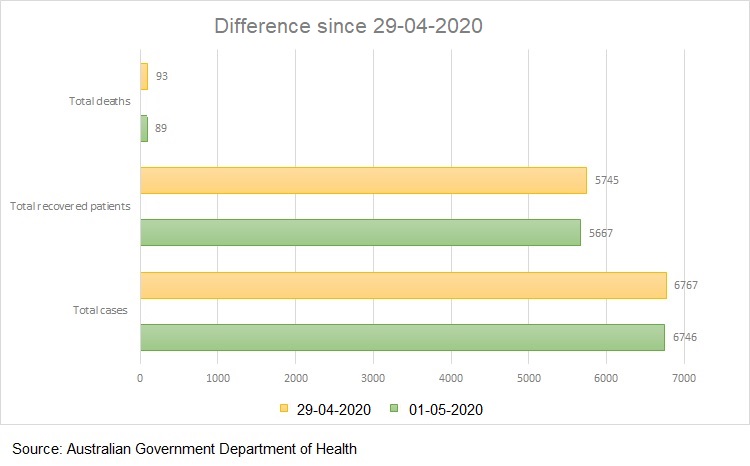
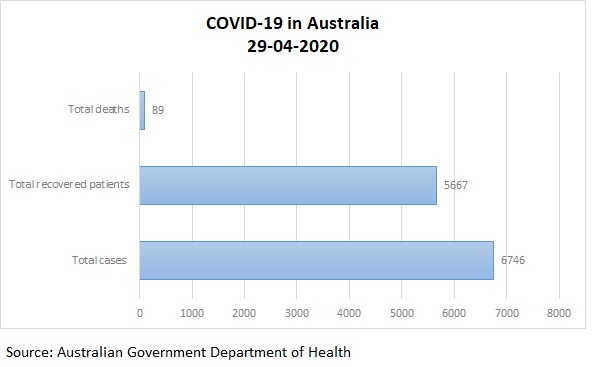
Things are changing in Australia, and overall things seem to go quite well. The death toll rises slowly, and in New South Wales, the Northern Territory and Tasmania there is an ease of the restrictions.

However, there are problems with community transmission in nursing homes. In a Sydney aged care facility, there have been thirteen people who passed away because of corona. In a Melbourne aged care home there now are five cases of the disease. The facility is in lockdown and everyone will get tested. It is unknown who patient zero was. The state Victoria (where Melbourne is situated) already has strict measures and these are not lifted.

In two days time there have only been a few new cases and deaths.

COVIDSafe App
Yve talks about a coronavirus tracing app that is now being used in her country. This app is called COVIDSafe, which helps to quickly contact people who have been exposed to the virus. It is voluntary to use, but on the website of the Australian Government Department of Health it says: ‘Downloading the app is something you can do to protect you, your family and friends and save the lives of other Australians. The more Australians connect to the COVIDSafe app, the quicker we can find the virus‘.

The app works with bluetooth. Phones take note of other app users that are nearby. The information, which is unaccesable for people, is encrypted and stored on a phone for 21 days. Once someone tests positive for COVID-19, the information can be given to state health officials. They can then easily reach out to the people who have been in contact with the patient. The collected information will be someone’s phone number, name, age range and postal code.

Privacy concerns
According to the government nobody has to be worried about their privacy when using the app. The only goal is to improve contact-tracing. The app will only show people who have been less than 1.5 meters from you, for longer than fifteen minutes. The information will be stored encrypted and securely, and there will be no live tracking. After the corona crisis all the data will be deleted.

Amazon hosts the data which is not ideal according to some people. Although Amazon has promised to keep the data safe, there is a catch. The 2018 US Cloud Act. Because of this law any data stored by an American cloud service is obtainable by the US law enforcement under a subpoena.

Extras
Watch this video if you want to know more about how the COVIDSafe App works.

Curious about what the US Cloud Act could mean for users of the corona app? Read this article.

Yve talked about how the government is funding schools to open quickly. For more information about this you can read this article.

Isha – Week One

Isha tells us how the last few weeks have been in Seoul (South Korea) and what her company, Samsung, does to ensure people can still work safely. If you want to know more about Isha, click here to read her bio.

Press the play button to listen to what Isha has to say.

Current situation in South Korea 30-04-2020

On the 20th of January South Korea saw its first case of COVID-19. Almost a month later on February 17 there were only thirty cases of infection. But this quickly changed after an infected person visited a big religious gathering. There was a sharp increase, and by the 29th of February there were 3.150 cases. This made it the second largest outbreak after mainland China.

However, South Korea had already been working on test kits for a while and were well prepared for an outbreak. The government believes that testing is the key to control the spread of the virus. If they detect the virus, they can isolate and threat the patients early on. Besides test kits they also produced a lot of facemasks.

Testing can be done via a special drive-through so people don’t have to leave their car. There are 600 locations that can screen up to 20.000 people per day. Everyone can get tested, and if you have any (light) symptoms it’s for free.

There is no lockdown in South Korea, people can still go outside if they wear a facemask. Contact tracing is also an important measure by which South Korea seems to have flattened the curve. There is a special app that will send people notifications if there is a person who has COVID-19 in their area. People who get a notification are more careful and may avoid some places.

Since there are no restrictions of movement in South Korea, disinfecting is important. Streets, public transport and other open spaces are continuously disinfected. There also bottles of disinfectant on intersections and shops. At home people will also disinfect their groceries.

All of these measures seem to have worked because on the 30th of April there are, for the first time since February, no new domestic cases of the coronavirus. There are four new infections, but they are all imported cases.

Extras

You can watch this video if you want to know more about the strategy of South Korea, or read this article.

Yve – Week One

Yve lives in Lilydale, a suburb of Melbourne. She works as a secondary school teacher. Click here if you want to know more about Yve.

Press the play button to listen how Yve is coping with the outbreak of COVID-19, and how she hopes this pandemic will make some positive changes.

Current situation Australia 29-04-2020

The first case of COVID-19 arrived in Victoria on the 25th of January. This patient just returned from a trip in Wuhan. Almost a month later, on the 27th of February, Prime Minister Scott Morrison said: “We believe the risk of global pandemic is very much upon us and as a result, as a government, we need to take the steps necessary to prepare for such a pandemic”. He announced that there would be an emergency plan to deal with the outbreak of COVID-19. At this time there was already a travel ban for people who had travelled in mainland China.

The number of COVID-19 cases rose dramatically in March. From 78 cases on the 12th of March to 877 by March 20th. This led to a lot of new rules. On March 15 anyone who arrived in Australia from overseas was forced to self-isolate for two weeks. Five days later Australia closed borders to non-residents. On the 22nd the Prime Minister’s Office released a media statement with measures that could be in place for the next six months. Some of these new measures were:

– Pubs, licensed clubs, gyms, cinemas, hotels, restaurant, cafes, casino’s, places of worship and funerals would be closed
– If possible people should keep 1.5 meter distance between themself and others
– Restrictions on entering aged care homes
– Non-essential gathering of more than 100 people inside are not allowed

The measures helped to flatten the curve and by the end of April authorities slowly stared to ease restrictions. On the 28th of April Bondi Beach in Sydney opened, after it was closed for a month. On the downside there was bad news about the remote education of children.

According to a number of reports that were commissioned by the Federal Education Department up to half of the Australian children and adolescents can be negatively affected because of remote learning. The report showed that more children became ‘vulnerable’, because things became harder at home due to the new measures. Watch this video if you want to know more about this (start at 4:15), or read this article.

Ananya – Week One

Ananya is stuck at her family home with her two grandparents in an Indian village. She left her room at her college in a hurry, without her laptop or books, because she thought the lockdown wouldn’t last that long. Now she is bored and feels guilty for not having anything to do. If you want to know more about Ananya, click here to read her bio.

Press the play button to listen to how Ananya has been feeling the last few weeks.

Current situation in India 26-04-2020

The biggest lockdown in the world is happening right now in India, where roughly 1.3 billion people have to stay inside. There is no public transport, schools and universities are closed and the final exams are postponed. On March 25, when there were approximately 500 cases of COVID-19, the lockdown was announced. This immediately led to a lot of problems. There are circa 139 million migrant workers in India. They have moved to cities and towns to get a job with a daily wage. Suddenly these workers have no income, so a lot of them wanted to go back to their places of origin. Since there was no public transport, there was a mass exodus of people trying to get back home to their families.

The lockdown would initially last till at least the 14th of April, but it has been extended till the 3rd of May.

Ananya gives a timeline of the situation in India. Press the play button to listen to her accounts of what has happened in her country for the last few weeks.

Extras
In the audiomessage above Ananya explained that the state Kerala has been succesfull in flattening the curve. If you want to know more about this click here to read more.

If you want to get an impression of Holi, the festival of colours, you can watch this video.

Kranti – Week One

Kranti lives in Leuven, a city in Flanders Belgium, it’s located about 25 kilometers (16 miles) west from Brussels. If you want to know more about Kranti, click here to read her bio.

Press the playbutton the listen to her introduction and how life has been so far since the virus spread in Belgium.

Current situation in Belgium 25-04-2020

According to the Belgium government the numbers of Saturday the 25th of April showed that there was a slight decrease of hospitalization of COVID-19 patients. Compared to the day before there were 809 new cases. Because the numbers are still high the government asks people to:
– Stay inside, especially when they’re sick
– Wash their hands regularly with soap
– Keep 1.5 meter distance of others
– Limit physical contact with others
– Wear a facemask in public transport and crowded places

Belgium has been in lockdown since the 18th of March. According to the Belgium government is is a ‘light’ lockdown. People are advised to leave their house daily for a walk or to cycle to get some fresh air. They are also allowed to keep seeing one friend in real life.  However, non-essential shops are closed, employers have to let their employees work from home (when possible), and non-essential traveling are all prohibited. People are not allowed to sit outside on benches or to gather in groups. If they do so, they can get a fine. Also, people cannot take longer than thirty minutes to get groceries in the supermarkets. Schools, restaurants and bars had already closed a few days prior to the lockdown. When the government made this decision, there were 1212 cases of the virus and ten patients had died.

On the 24th of April the National Security Council came together to discuss a corona exit strategy. The current measures will remain till at least the third of May, after that there might phase out the measures. Although there is a decrease in the number of hospitalization and deaths, the virus is still present on Belgium territory and remains dangerous according to the government.

Extras
Are you curious about Leuven, the city where Kranti lives? Watch this video to get an idea.